
Turnstile Access Control: A Complete Guide to Facility Security
Controlling who enters your facility is one of the most important parts of a comprehensive physical security strategy. Commercial buildings, corporate offices, distribution centers, government facilities, data centers, manufacturing plants, and other high security environments need more than a locked door and an access card to protect their people and property.

An employee may be required to scan a badge to unlock a door, but what prevents another person from walking in behind them?
That is one of the vulnerabilities turnstile access control systems are designed to address.
By combining a physical barrier with electronic access control, turnstiles create a controlled point of entry where credentials can be verified before access is granted. Depending on the facility, turnstiles can also integrate with card readers, biometric technology, mobile credentials, visitor management systems, CCTV, and other security infrastructure.
For organizations looking to strengthen physical security while maintaining an efficient flow of employees and visitors, turnstile access control can become a critical first line of defense.
What Is Turnstile Access Control?
Turnstile access control combines a physical turnstile with an electronic credentialing system to control pedestrian entry and exit.
Instead of simply unlocking a door when someone presents an approved credential, the system controls passage through a designated lane. Depending on the turnstile and configuration, the user may scan an ID card, present a mobile credential, or authenticate through a biometric reader before being permitted to pass.
This creates a physical connection between identity verification and entry.
Traditional access controlled doors can still be an important part of a security strategy, but they may leave facilities vulnerable to tailgating or piggybacking. Once a door opens, more than one person may be able to enter before it closes.
Turnstiles provide an additional layer of control by creating individual pedestrian lanes and regulating movement through the secured entry point.
Why Are Turnstiles Important for Facility Security?
Modern facilities often need to balance two competing priorities: strong security and efficient pedestrian flow.
Employees need to get to work. Visitors need a straightforward check in process. Contractors and vendors may require temporary access. At the same time, security teams need greater control over who can enter restricted areas.

A properly designed commercial turnstile system can help facilities accomplish both.
Turnstiles can help:
Create clearly defined entry and exit points
Restrict unauthorized pedestrian access
Reduce opportunities for tailgating and piggybacking
Verify credentials before allowing entry
Improve visibility into pedestrian traffic
Support employee and visitor access policies
Create records of access activity when integrated with compatible systems
Strengthen physical security at sensitive areas
Manage high volumes of pedestrian traffic
Rather than relying solely on employees or security personnel to identify unauthorized entry, turnstiles introduce a physical checkpoint into the access control process.
Choosing the Right Type of Turnstile
There is no single turnstile design that works for every facility. The right solution depends on factors such as the required level of security, location, available space, pedestrian volume, accessibility requirements, existing access control technology, and the appearance of the surrounding environment.
Understanding the major types of turnstiles can help organizations determine which solution best fits their facility.
Full Height Turnstiles
Full height turnstiles provide one of the strongest physical barriers available for pedestrian access control.

Unlike waist height models, full height systems extend from near the floor to above head level, creating a more substantial barrier around the entry lane. Their design makes them well suited for locations where physical security is a primary concern.
Full height turnstiles are commonly considered for:
Distribution centers
Warehouses
Manufacturing facilities
Industrial properties
Government facilities
Transportation and infrastructure sites
Employee entrances
Secured perimeter access points
They can also be paired with pedestrian security gates to accommodate specific operational and accessibility requirements.
For facilities where preventing unauthorized physical entry takes priority over aesthetics, a full height turnstile can provide a durable and highly visible security checkpoint.
Optical Turnstiles
Optical turnstiles are designed for environments where security, pedestrian throughput, and appearance all matter.

These systems use sensors to monitor passage through the lane and are often paired with glass barriers or gates. Their streamlined appearance makes them particularly well suited to modern interior spaces.
Optical turnstiles are frequently used in:
Corporate headquarters
Office buildings
Commercial properties
Government buildings
High rise lobbies
Universities
Financial institutions
Hospitality environments
For a busy corporate lobby, an optical turnstile system can help process authorized employees efficiently while maintaining a clean, professional entrance.
Waist Height Turnstiles
Waist height turnstiles offer a compact and practical way to manage pedestrian traffic.
They provide a clear physical checkpoint without creating the larger footprint or imposing appearance associated with full height systems.

Depending on the application, waist height turnstiles may be appropriate for commercial facilities, campuses, recreational facilities, entertainment venues, employee entrances, and other locations that need an organized way to manage pedestrian access.
Biometric Turnstiles
For facilities requiring a more advanced method of identity verification, biometric turnstiles can combine controlled pedestrian access with biometric authentication technology.

Depending on the system, biometric authentication may include facial recognition, fingerprint readers, or other compatible identity verification technologies.
Instead of relying solely on something a person possesses, such as an access card, biometric systems can provide an additional method of confirming that the person requesting access is actually the authorized user.
This can be particularly valuable in high security environments where identity verification is a major priority.
Turnstiles Help Address Tailgating and Piggybacking
One of the most important reasons organizations install turnstiles is to create greater control over tailgating and piggybacking.
With a conventional access controlled door, an authorized employee can present a credential and open the door. Another person may then attempt to follow them through without presenting their own credential.

This creates a gap between the electronic access control system and the physical reality of who actually entered the building.
Turnstiles help close that gap.
By creating individual controlled lanes, a properly configured system can require users to interact with the access control system before passing through the secured point.
For facilities with hundreds or thousands of employees moving through entrances each day, adding this physical layer can significantly improve the consistency of access procedures.
Integrating Turnstiles With Your Existing Access Control System
A turnstile should not be viewed as an isolated piece of hardware. The strongest installations consider how the turnstile will interact with the facility's broader security infrastructure.
Depending on the technology already in place and the requirements of the project, turnstiles may be integrated with:
Employee card readers
Mobile access credentials
Biometric readers
Visitor management systems
CCTV and video surveillance
Alarm systems
Security monitoring platforms
Building access control systems
This creates a more connected approach to physical security.

When an authorized credential is presented, the access control system can communicate with the turnstile to permit passage. If a credential has been deactivated or access is otherwise denied, the turnstile remains secured.
When supported by the integrated access control platform, access events can also create useful records that help security teams understand when credentials were used and at which entry points.
Connecting Turnstile Access Control With CCTV
Turnstiles and video surveillance can complement one another as part of a broader security strategy.
CCTV systems provide visual monitoring, while turnstiles provide physical control over pedestrian movement.
Together, they can give security teams greater visibility around critical entry and exit points. Cameras positioned around turnstile areas can help monitor activity, investigate incidents, and provide visual context around access events.
This layered approach is particularly valuable for facilities where entrances represent a critical security boundary.
Turnstile Access Control for Distribution Centers and Industrial Facilities
Distribution centers, warehouses, and industrial properties present unique security challenges.
Large workforces may enter and exit during concentrated shift changes. Contractors and vendors may require separate access. Valuable inventory and equipment may be located inside the facility, and certain operational areas may need to remain restricted.

Full height turnstiles can provide a strong physical access point for these environments while helping facilities establish clearly defined pedestrian routes.
A properly planned installation can help separate pedestrian traffic from other operational activity and create controlled entry points without unnecessarily disrupting the movement of authorized employees.
Turnstiles for Corporate Offices and Commercial Buildings
The security requirements of a corporate lobby can be very different from those of a warehouse.
Businesses want employees to enter efficiently, but the entrance is also often the first impression visitors have of the organization. Large, visually imposing barriers may not complement the design of the space.
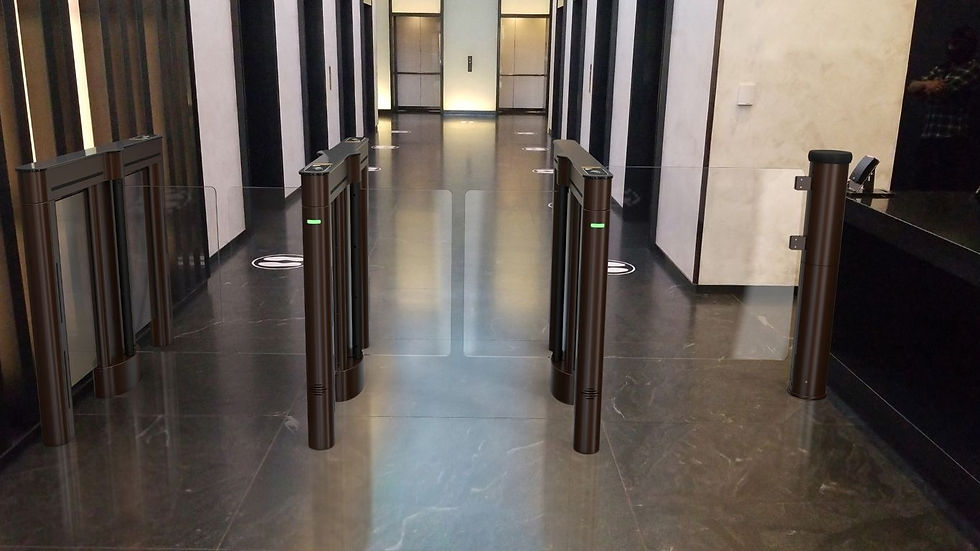
Optical turnstiles can provide a balance between security and aesthetics.
Modern systems can feature streamlined housings, glass barriers, integrated credential readers, and multiple lanes configured around the expected volume of pedestrian traffic.
When properly planned, the result is an entrance that feels like part of the architecture rather than security equipment added as an afterthought.
Planning for Pedestrian Traffic and Peak Entry Times
One of the most overlooked parts of a turnstile installation is throughput.
A facility may have excellent security technology, but if too few lanes are installed, employees can quickly form lines during shift changes or morning arrival periods.
Turnstile planning should therefore consider more than the physical dimensions of the entrance.
Important considerations include:
Number of employees using the entrance
Peak arrival and departure periods
Expected visitors and contractors
Number of available turnstile lanes
Entry and exit configuration
Accessibility requirements
Emergency egress requirements
Available installation space
Future facility growth
These factors help determine not only which type of turnstile to use, but how the entire access point should be configured.
Why Professional Turnstile Installation Matters
Selecting the right equipment is only part of a successful project.
Turnstiles must be positioned correctly, securely installed, and coordinated with the surrounding building infrastructure and access control technology.
A professional turnstile installation begins by understanding the facility itself.
That means evaluating pedestrian flow, existing access points, available space, security requirements, electrical and access control infrastructure, and how the system will be used during everyday operations.

At Spade Security, we provide turnkey turnstile and access control solutions tailored to the requirements of each facility. Our capabilities include product selection, installation, system integration, and on site training, helping organizations manage the project through a single security partner.
Rather than approaching every project with the same equipment and configuration, we work around the specific security and operational needs of the property.
Turnstiles Are One Part of a Layered Security Strategy
No single security product can address every risk facing a facility.
Turnstiles are most effective when incorporated into a broader physical security strategy that may also include access control, CCTV, pedestrian gates, vehicle access systems, security fencing, bollards, guard shacks, and other perimeter security measures.
The goal is to create multiple layers of protection.
A facility may use vehicle barriers to control the outer perimeter, turnstiles to manage pedestrian entry, electronic access control to verify credentials, and CCTV to provide visual monitoring.
Each layer serves a different purpose, but together they create a more comprehensive approach to facility security.
The Long Term Value of Turnstile Access Control
A well designed turnstile access control system does more than create a physical barrier.
It gives organizations greater control over how people move into and through their facilities. It can strengthen access procedures, create more organized entrances, support security monitoring, and help organizations make better use of their existing access control technology.
Most importantly, the right system should work around the way the facility actually operates.
A corporate headquarters may prioritize fast pedestrian throughput and aesthetics. A distribution center may prioritize durability and employee access during shift changes. A government facility may require multiple layers of physical security and identity verification.
The solution should reflect those differences.
Upgrade Your Facility With Professional Turnstile Installation
If your organization is relying primarily on traditional doors or manual security checks to control pedestrian access, it may be time to evaluate whether turnstiles can strengthen your physical security strategy.
We design and install turnstile access control systems for commercial, industrial, government, institutional, and other high security environments. From optical and waist height turnstiles to full height and biometric solutions, we can help determine the right configuration for your facility and integrate it with your broader security infrastructure.
Explore our turnstile solutions or contact us to discuss your facility, security requirements, and upcoming project.


Comments